
Key facts
- Zopiclone vs eszopiclone in one line: eszopiclone is the active half of the zopiclone molecule. The FDA label calls it the S-isomer of racemic zopiclone.
- Eszopiclone (brand name Lunesta, plus generics) is FDA-approved for insomnia. Zopiclone has never been approved by the FDA.
- Both are Schedule IV controlled substances under US federal law.
- In a head-to-head trial, eszopiclone worked about as well as zopiclone over four weeks, with similar side effects.
- Both carry the same core risks: next-day drowsiness, complex sleep behaviors, a bitter taste and dependence with long-term use.
- US guidelines recommend CBT-I, not a pill, as the first treatment for chronic insomnia.
If you have ever been prescribed zopiclone abroad and then asked a US doctor for it, you were probably offered eszopiclone instead. The zopiclone vs eszopiclone question comes up because the two names look almost identical, and in a sense they are: eszopiclone is a refined version of zopiclone. But they are not the same product, they are not dosed the same way, and only one of them is legally sold in the United States. Our complete guide to zopiclone covers the older drug in depth. This article focuses on what actually differs between the two and what that means for you as a US patient. If you are ready to talk to a prescriber, our guide to getting a Lunesta prescription covers the steps.
What makes them related: one molecule, two mirror images
Many medicines are built from molecules that come in two mirror-image versions, the way your left and right hands match but cannot be stacked on top of each other. Chemists call these versions enantiomers. Zopiclone is a “racemic” drug, meaning each dose contains an equal mix of both versions.
Eszopiclone contains only one of them. The FDA-approved Lunesta prescribing information describes eszopiclone as “the S-isomer of racemic zopiclone.” The S-version carries most of the sleep-promoting effect.
So in plain terms: zopiclone is a 50/50 mix of two forms, and eszopiclone is the active form on its own. That is why milligram amounts are not comparable between them, and why switching from one to the other is a prescriber’s call, not a simple swap.
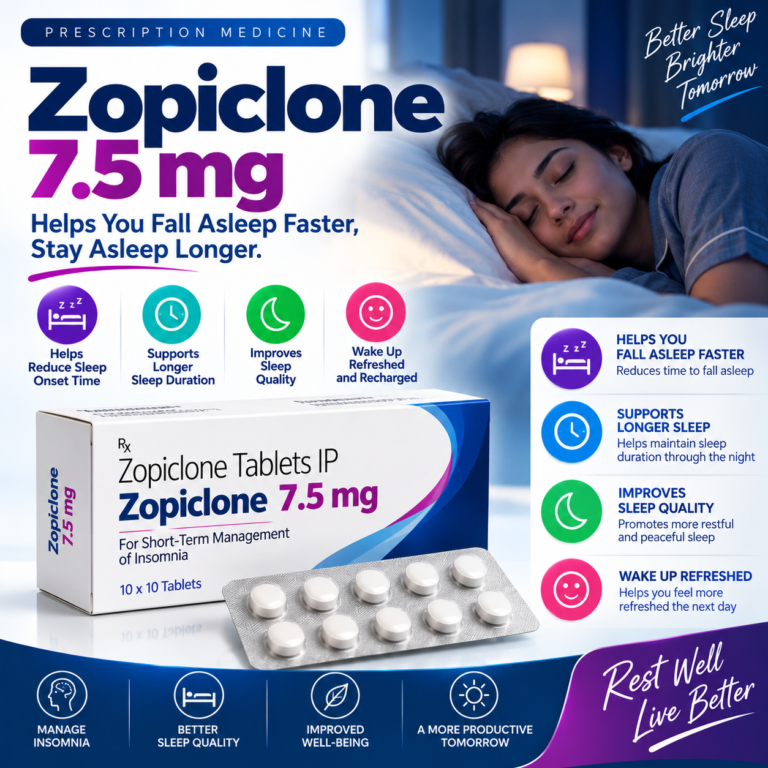
Zopiclone vs eszopiclone: side-by-side comparison
| Feature | Zopiclone | Eszopiclone (Lunesta) |
|---|---|---|
| What it is | Racemic mix of both mirror-image forms | The S-form only |
| FDA status | Never approved; not sold in US pharmacies | Approved for insomnia since 2004; generics available |
| DEA schedule | Schedule IV | Schedule IV |
| How long it lasts | Similar overnight duration; see our zopiclone guide | Half-life about 6 hours (about 9 hours in adults 65+) |
| FDA boxed warning | Not applicable (no US label) | Yes, for complex sleep behaviors |
| Bitter taste | Most common complaint in older reviews | Most common side effect in US trials |
| US-labeled dosing | None | Starts at 1 mg; maximum 3 mg (2 mg for older adults) |
For a closer look at each of these, including why the metallic taste happens and how long next-day drowsiness lasts, see our full guide to zopiclone side effects.
Why the US has eszopiclone but not zopiclone
A prescription drug can only be marketed in the US after the FDA reviews and approves it. Zopiclone was developed and launched outside the US and was never submitted for, or granted, FDA approval. Instead, a US company developed the single-form version, and the FDA approved it as Lunesta in 2004. The label still lists “Initial U.S. Approval: 2004.”
Controlled-substance law adds a second layer. Even though zopiclone was never approved, the DEA added it to Schedule IV in a final rule published in the Federal Register on April 4, 2005. Eszopiclone is also Schedule IV, the same category as zolpidem (Ambien), zaleplon and benzodiazepines, according to its label. For how the Z-drugs differ from each other, see zopiclone vs zolpidem and zaleplon.
In practice, this means a US pharmacy cannot fill a zopiclone prescription. The FDA’s personal importation guidance states that a drug approved in another country but unapproved in the US is generally illegal to import, and that personal importation of controlled substances falls under DEA rules. If you are moving to the US or visiting and you take zopiclone at home, the safest step is to talk to a US prescriber before your supply runs out.
Do they work differently?
Less than you might expect. The best direct evidence is a phase III randomized, double-blind trial published in the journal Clinics in 2016, which compared the two head to head in 199 adults with insomnia over four weeks. According to the study abstract on PubMed, eszopiclone was “non-inferior” to zopiclone on the Insomnia Severity Index, meaning it performed at least as well. Sleep-lab recordings also showed eszopiclone improved total sleep time and sleep efficiency.
The same trial found a similar side-effect profile in both groups. The most common complaints were taste disturbance (dysgeusia), headache, dizziness, irritability and nausea.
Two caveats matter. First, this was a single study at one center, so it cannot settle every question. Second, four weeks is too short to show differences in tolerance, dependence or withdrawal, which are the issues that tend to matter most with sleeping pills used for months.
The bitter taste: a shared trait
Both drugs are known for leaving a bitter or metallic taste. A 1998 review of zopiclone in the journal Drugs, summarized on PubMed, called a bitter aftertaste the most common adverse event, reported by 3.6% of people in the largest postmarketing study. For eszopiclone, the US label’s six-week trial in non-elderly adults reported an unpleasant taste in 17% of people on 2 mg and 34% on 3 mg, compared with 3% on placebo.
Those numbers come from very different kinds of studies, so they are not a fair head-to-head score. What they do show is that taste changes are common with both, and with eszopiclone they become more likely at higher doses.
What the US eszopiclone label says about dosing and timing
Because zopiclone has no US label, the only US dosing information comes from eszopiclone. According to the FDA label:
- The recommended starting dose is 1 mg, taken immediately before bedtime, and it can be raised to 2 mg or 3 mg if clinically needed. The total should not exceed 3 mg once a night.
- For older or debilitated adults, the dose should not exceed 2 mg. Adults 65 and older had about 41% higher exposure and a longer half-life of roughly 9 hours.
- For people with severe liver impairment, or who take strong CYP3A4-blocking medicines, the dose should not exceed 2 mg.
- It should only be taken when you can stay in bed for a full 7 to 8 hours. MedlinePlus adds that it should not be taken with or right after a heavy, high-fat meal, which slows its effect.
Eszopiclone reaches peak levels in about 1 hour and has a half-life of about 6 hours, so some of it is still active in the morning. The label warns that people taking 3 mg should not drive or do anything that needs full alertness the next day, and that impairment can happen even when you feel fine.
Shared safety warnings
Swapping zopiclone for eszopiclone does not remove the risks that come with this whole drug family.
Complex sleep behaviors
In April 2019, the FDA added a boxed warning to eszopiclone, zaleplon and zolpidem after reports of sleep-walking, sleep-driving and other activities done while not fully awake, some of which led to serious injuries and deaths. Anyone who has had one of these episodes should not take these medicines again. Our guide to the Z-drug boxed warning explains what the warning says, who should avoid these drugs and what to do if an episode happens.
Next-day impairment and falls
Grogginess, slowed reactions and poor coordination the morning after are possible with both drugs. The eszopiclone label notes that older adults face a higher risk of falls.
Dependence and withdrawal
Both are Schedule IV because they can cause physical dependence. Stopping suddenly after regular use can lead to rebound insomnia and withdrawal symptoms such as anxiety. Any plan to stop should be made with your prescriber.
Mixing with alcohol or other sedatives
Alcohol, opioid pain medicines, other sleep aids and many anxiety medicines all add to the sedating effect. The eszopiclone label advises against combining it with other sedative-hypnotics at bedtime.
When to get emergency help: Call 911 if someone who took a sleeping medicine is very hard to wake, has slow or shallow breathing, or has blue lips. For a possible overdose or a child who swallowed a pill, call Poison Help at 1-800-222-1222. If you have thoughts of harming yourself, call or text 988. Contact your prescriber promptly if you do anything during the night you cannot remember, or if you feel unsafe to drive the next morning.
Better first steps for insomnia
Neither drug is meant to be the first answer for long-term sleep problems. The American College of Physicians recommends cognitive behavioral therapy for insomnia (CBT-I) as the first-line treatment for adults with chronic insomnia, and notes that FDA-approved sleep medicines were studied mainly for short-term use of four to five weeks.
If a medicine does make sense for you, the US option in this family is eszopiclone, and your prescriber can weigh it against other choices based on your age, other medicines and how your insomnia shows up.
Questions to ask your prescriber
- I used zopiclone in another country. Is eszopiclone a reasonable substitute for me, and what dose would you start with?
- Could any of my other medicines, including antifungals or certain antibiotics, raise my eszopiclone levels?
- How soon after a dose is it safe for me to drive?
- How long should I plan to take it, and what is the plan for stopping?
- Can you refer me to CBT-I or a sleep specialist?
Frequently asked questions
Is eszopiclone the same as zopiclone?
Not exactly. Zopiclone is a 50/50 mix of two mirror-image forms of the same molecule, and eszopiclone is only the active S-form. They are closely related, but they are separate products with different doses.
Is eszopiclone stronger than zopiclone?
Eszopiclone is given in smaller milligram amounts because it contains only the active form, but that does not make it a more powerful sleeping pill. In a four-week head-to-head trial, the two worked about equally well with similar side effects.
Can I get zopiclone in the US?
No US pharmacy can dispense it, because zopiclone has never been approved by the FDA. It is also a Schedule IV controlled substance. US prescribers typically consider eszopiclone or non-drug treatment such as CBT-I instead.
Do both cause a bitter taste?
Yes. A bitter or unpleasant taste is one of the most common side effects of both drugs. With eszopiclone it becomes more common at higher doses.
Is eszopiclone a benzodiazepine?
No. It has a different chemical structure, but it acts on the same brain receptor system and shares some of the same effects and risks, which is why it is in the same Schedule IV category.
Related guides
- Zopiclone: What It Is and Why It Isn’t Sold in the US
- Zopiclone Side Effects: Metallic Taste, Next-Day Drowsiness and More
- Zopiclone vs Zolpidem (Ambien) vs Zaleplon: Z-Drugs Compared
- Can You Buy Zopiclone for Insomnia in the US? Prescription Rules and Legal Options
- Tapentadol (Nucynta): Uses, How It Works and Safety (why opioid pain medicines and sleeping pills should not be mixed)
- Zopiclone for Insomnia: How It Works and What US Patients Use Instead
- Is Zopiclone a Benzodiazepine?
- Complex Sleep Behaviors: The FDA Boxed Warning on Z-Drugs
- Zopiclone Dependence, Tolerance and Withdrawal
- Zopiclone and Alcohol, Opioids and Other Interactions
- Sleep Medicines in Older Adults: Falls and the Beers Criteria
- CBT-I and Non-Drug Insomnia Treatments
- Bringing Zopiclone into the US: FDA and DEA Import Rules
- Getting a Lunesta (Eszopiclone) Prescription for Insomnia
Sources
- US Food and Drug Administration. LUNESTA (eszopiclone) tablets: Full prescribing information, revised August 2019.
- MedlinePlus, US National Library of Medicine. Eszopiclone.
- US Food and Drug Administration. Certain prescription insomnia medicines: New boxed warning due to risk of serious injuries caused by complex sleep behaviors, April 30, 2019.
- Drug Enforcement Administration. Schedules of Controlled Substances: Placement of Zopiclone Into Schedule IV. Federal Register, April 4, 2005 (70 FR 16937).
- US Food and Drug Administration. Personal Importation.
- Pinto LR Jr, Bittencourt LRA, Treptow EC, Braga LR, Tufik S. Eszopiclone versus zopiclone in the treatment of insomnia. Clinics (Sao Paulo), 2016 (PubMed).
- Noble S, Langtry HD, Lamb HM. Zopiclone: An update of its pharmacology, clinical efficacy and tolerability in the treatment of insomnia. Drugs, 1998 (PubMed).
- American College of Physicians. ACP Recommends Cognitive Behavioral Therapy as Initial Treatment for Chronic Insomnia, May 3, 2016.