
Key facts
- The best-known zopiclone side effects are a bitter or metallic taste and drowsiness that can carry over into the next morning.
- Studies show a 7.5 mg bedtime dose of zopiclone impairs driving the next morning more than a blood alcohol level of 0.05%.
- Rarer but serious effects include sleepwalking, sleep-driving and other complex sleep behaviors, memory gaps, mood changes and breathing problems when mixed with alcohol or opioids.
- Zopiclone is not FDA-approved and is not sold in US pharmacies. It is a Schedule IV controlled substance. Its close relative eszopiclone (Lunesta) is the FDA-approved option.
- Older adults face higher risks of falls and fractures with Z-drug sleep medicines.
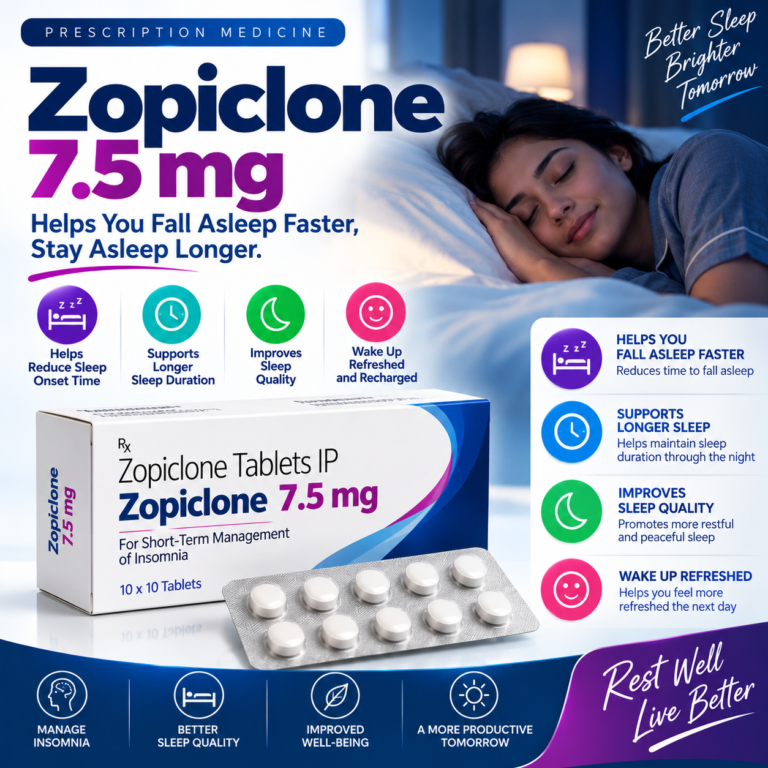
Zopiclone (see our zopiclone guide) is a short-term sleeping medicine widely prescribed in Europe, Canada and elsewhere. Because many US readers come across it while traveling, living abroad or reading about insomnia online, it helps to know what to expect. This guide covers the most common zopiclone side effects, why the metallic taste happens, how long next-day drowsiness can last, and the rarer reactions that need urgent attention.
Zopiclone has never been approved by the FDA, so there is no US prescribing label for it. Much of the safety information below comes from peer-reviewed research on zopiclone and from the FDA label for eszopiclone (Lunesta), which is the active half of the zopiclone molecule and shares its main side effects. Our guide to zopiclone vs eszopiclone explains how the two relate.
The most common zopiclone side effects
People who take zopiclone or eszopiclone most often report:
- A bitter, metallic or unpleasant taste
- Drowsiness, grogginess or slowed reactions the next day
- Dry mouth
- Headache
- Dizziness
The FDA prescribing information for Lunesta gives a sense of how often these occur. In a six-week trial in adults, the rates were:
| Side effect | Placebo | Eszopiclone 2 mg | Eszopiclone 3 mg |
|---|---|---|---|
| Unpleasant taste | 3% | 17% | 34% |
| Headache | 13% | 21% | 17% |
| Sleepiness (somnolence) | 3% | 10% | 8% |
| Dizziness | 4% | 5% | 7% |
| Dry mouth | 3% | 5% | 7% |
These figures come from eszopiclone, not zopiclone itself, but they show the pattern: taste problems are common and get more likely as the dose rises.
Why zopiclone causes a metallic taste
The bitter or metallic taste is so common that many people recognize zopiclone by it. It happens because the drug passes into saliva. In an early study in volunteers, Caille and colleagues (1984) found that people reported a bitter taste about 24 minutes after a 7.5 mg dose, at the point when the drug showed up in their saliva. A later study of therapeutic doses by Hjelmeland and colleagues (Forensic Science International, 2017) found zopiclone levels in saliva were typically about three times higher than in blood, and traces could be found in saliva for a day or more.
With eszopiclone, a controlled study by Doty and colleagues (2009) found that most people taking the drug noticed a taste change, usually bitter or metallic, compared with far fewer on placebo. The taste was worst in the morning and tracked with drug levels in blood and saliva.
The taste is unpleasant but not dangerous. It usually fades as the drug clears. If it bothers you, mention it to your prescriber rather than changing how you take the medicine.
Next-day drowsiness and driving
The side effect with the biggest safety impact is grogginess the morning after. Zopiclone lasts longer than other Z-drugs. A toxicology review by Gunja (Journal of Medical Toxicology, 2013) notes that zopiclone has the longest duration of action of the Z-drugs and the greatest residual effect, similar to short-acting benzodiazepines.
Driving research makes the risk concrete. Zopiclone 7.5 mg is so reliably impairing that researchers use it as the comparison drug when testing new sleep medicines. Pooling eight on-the-road studies with 191 healthy volunteers, Verster and colleagues (Current Drug Safety, 2011) found that a bedtime dose significantly increased weaving on the road the next morning, by more than a blood alcohol level of 0.05%. A larger meta-analysis by Roth and colleagues (Traffic Injury Prevention, 2014) confirmed impaired driving 10 to 11 hours after taking it at bedtime.
The FDA reached a similar conclusion for eszopiclone. In a 2014 Drug Safety Communication, it lowered the recommended starting dose of Lunesta to 1 mg after a study found that 3 mg could impair driving, memory and coordination for more than 11 hours, often without people realizing it.
Practical steps that lower the risk:
- Take a sleep medicine only when you can stay in bed for a full night (7 to 8 hours).
- Do not drive or do anything that needs full alertness until you know how the medicine affects you the next day, even if you feel awake.
- Never take an extra dose in the middle of the night unless your prescriber has told you to.
- Avoid alcohol, which adds to the sedation.
Rare but serious zopiclone side effects
Complex sleep behaviors
Sleepwalking, sleep-driving, cooking or making phone calls while not fully awake have been reported with Z-drugs. In 2019 the FDA added a boxed warning, its strongest warning, to eszopiclone, zaleplon and zolpidem after identifying 66 cases of serious injury, including 20 deaths. Anyone who has had one of these episodes should not take these medicines again. Our guide to the Z-drug boxed warning explains what the warning says, who should avoid these drugs and what to do if an episode happens.
Memory, thinking and mood changes
The Lunesta label warns about memory gaps (amnesia), confusion, unusual behavior, agitation and hallucinations. It also warns that sleep medicines can worsen depression and, in some people, lead to suicidal thoughts.
Breathing problems and overdose
Like other sleep medicines, zopiclone slows down the central nervous system. The danger of deep sedation and slowed breathing rises when it is combined with alcohol, opioids or other sedatives. Gunja’s review notes that zopiclone poisoning mainly causes deep sedation and coma, and that deaths are rare and most often involve other drugs as well.
Allergic reactions
Swelling of the face, lips, tongue or throat and severe allergic reactions are rare but possible with this group of medicines.
Call 911 if someone taking zopiclone is very hard to wake, has slow or shallow breathing, has swelling of the face or throat, or has taken it with alcohol or opioids and seems unusually sleepy. For a possible overdose, you can also call Poison Help at 1-800-222-1222 (24/7). For thoughts of suicide, call or text 988.
Dependence, rebound insomnia and withdrawal
Zopiclone is meant for short-term use. A review in Canadian Family Physician by Cimolai (2007) described cases of dependence, and some people who stopped suddenly had severe rebound insomnia, anxiety, tremor, a racing heart and, rarely, seizures. The risk was higher in people with a history of substance use or psychiatric illness. US patient information for eszopiclone on MedlinePlus lists similar withdrawal symptoms. If you have taken a sleep medicine nightly for more than a few weeks, ask your prescriber how to stop safely rather than stopping on your own.
Older adults: falls and fractures
Older adults clear these drugs more slowly and are more sensitive to them. A meta-analysis by Treves and colleagues (Age and Ageing, 2018) found that Z-drug use was linked to a higher risk of fractures, with a trend toward more falls. In people living with dementia, Richardson and colleagues (BMC Medicine, 2020) found higher rates of falls and hip fractures at higher doses. The Lunesta label also notes that older adults are at higher risk of falls, and it caps the dose at 2 mg for them. For more on falls, driving and safer options after 65, see sleep medicines in older adults.
Zopiclone in the US: what to do instead
Zopiclone was placed in Schedule IV by the DEA in 2005 (Federal Register, 2005), but no zopiclone product is approved by the FDA, so US pharmacies do not dispense it. If you used zopiclone abroad and need ongoing help with sleep in the US, talk with a US prescriber. Options they may discuss include eszopiclone (Lunesta), other FDA-approved insomnia medicines, and cognitive behavioral therapy for insomnia (CBT-I), a structured non-drug treatment for long-term insomnia.
Questions to ask your prescriber
- Which side effects are most likely for me, given my age and other health conditions?
- How long should I wait before driving after a dose?
- Do any of my other medicines, including pain medicines or anxiety medicines, add to the sedation?
- How long should I use a sleep medicine, and how will we stop it?
- Is CBT-I an option for me?
- If I was taking zopiclone abroad, what is the right US alternative?
Frequently asked questions
What are the most common zopiclone side effects?
The most common are a bitter or metallic taste, next-day drowsiness, dry mouth, headache and dizziness. The taste and grogginess are the ones people notice most often.
Why does zopiclone leave a metallic taste?
Zopiclone passes into saliva, where its levels can be higher than in blood. That is why many people notice a bitter or metallic taste soon after a dose, and sometimes the next morning. It is unpleasant but not harmful.
Is it safe to drive the morning after taking zopiclone?
Not always. Driving studies show a 7.5 mg bedtime dose can impair driving the next morning, even when people feel awake. Do not drive until you know how the medicine affects you, and allow a full night in bed after any dose.
Can zopiclone cause sleepwalking or memory loss?
Yes, rarely. Z-drug sleep medicines can cause complex sleep behaviors such as sleepwalking and sleep-driving, as well as memory gaps. Anyone who has one of these episodes should stop the medicine and contact their prescriber.
Is zopiclone available in the United States?
No. Zopiclone is not FDA-approved and is not sold in US pharmacies, although it is a Schedule IV controlled substance. Eszopiclone (Lunesta), its active half, is the FDA-approved option a US prescriber may consider.
Related guides
- Zopiclone: What It Is and Why It Isn’t Sold in the US
- Zopiclone vs Eszopiclone (Lunesta): The US Equivalent Explained
- Zopiclone vs Zolpidem (Ambien) vs Zaleplon: Z-Drugs Compared
- Can You Buy Zopiclone for Insomnia in the US? Prescription Rules and Legal Options
- Modafinil Side Effects: Common, Rare and When to Get Help
- Zopiclone for Insomnia: How It Works and What US Patients Use Instead
- Is Zopiclone a Benzodiazepine?
- Complex Sleep Behaviors: The FDA Boxed Warning on Z-Drugs
- Zopiclone Dependence, Tolerance and Withdrawal
- Zopiclone and Alcohol, Opioids and Other Interactions
- Sleep Medicines in Older Adults: Falls and the Beers Criteria
- CBT-I and Non-Drug Insomnia Treatments
- Bringing Zopiclone into the US: FDA and DEA Import Rules
- Getting a Lunesta (Eszopiclone) Prescription for Insomnia
Sources
- Sunovion. LUNESTA (eszopiclone) tablets: Prescribing information. US Food and Drug Administration, 2019.
- US Food and Drug Administration. FDA adds Boxed Warning for risk of serious injuries caused by sleepwalking with certain prescription insomnia medicines. April 30, 2019.
- US Food and Drug Administration. FDA warns of next-day impairment with sleep aid Lunesta (eszopiclone) and lowers recommended dose. May 15, 2014.
- Gunja N. The clinical and forensic toxicology of Z-drugs. Journal of Medical Toxicology. 2013;9(2):155-162.
- Verster JC, Spence DW, Shahid A, Pandi-Perumal SR, Roth T. Zopiclone as positive control in studies examining the residual effects of hypnotic drugs on driving ability. Current Drug Safety. 2011;6(4):209-218.
- Roth T, Eklov SD, Drake CL, Verster JC. Meta-analysis of on-the-road experimental studies of hypnotics: effects of time after intake, dose, and half-life. Traffic Injury Prevention. 2014;15(5):439-445.
- Caille G, et al. Pharmacokinetic and clinical parameters of zopiclone and trimipramine when administered simultaneously to volunteers. Biopharmaceutics and Drug Disposition. 1984;5(2):117-125.
- Hjelmeland K, et al. Zopiclone concentrations in oral fluid and blood after administration of therapeutic doses of zopiclone. Forensic Science International. 2017;278:177-183.
- Doty RL, et al. A double-blind study of the influences of eszopiclone on dysgeusia and taste function. Pharmacology Biochemistry and Behavior. 2009;94(2):312-318.
- Cimolai N. Zopiclone: is it a pharmacologic agent for abuse? Canadian Family Physician. 2007;53(12):2124-2129.
- Treves N, et al. Z-drugs and risk for falls and fractures in older adults: a systematic review and meta-analysis. Age and Ageing. 2018;47(2):201-208.
- Richardson K, et al. Adverse effects of Z-drugs for sleep disturbance in people living with dementia: a population-based cohort study. BMC Medicine. 2020;18:351.
- National Library of Medicine. Eszopiclone: MedlinePlus Drug Information.
- Drug Enforcement Administration. Schedules of controlled substances: placement of zopiclone into Schedule IV. Federal Register. 2005;70(63).
- Health Resources and Services Administration. Poison Help.